Pages

Saturday, June 29, 2013

A Not-So-Tall Tree House Tale

It all started when my good wife made an innocent remark in the presence of a couple of our grandchildren, something like, “Maybe some time we’ll have to build you a little tree house in the back yard.”

Well, they never forgot that, and I, though more than a little leery of the idea at first, found myself starting to obsess over just how and where (and whether) we might make their little dream come true.

It so happened that an aging apple tree on our back yard showed some promise as a possible site, and before long I was making big time plans, in spite of my having less than stellar skills in the construction department. The whole project turned out to be a lot of fun.

Here are some things I learned:

Having good neighbors always helps when you lack experience and are operating on a low budget. A great retired senior on one side of us offered some helpful advice and the use of some of his tools--along with some ribbing about my needing a building permit for such a major project. Another neighbor offered some invaluable hands-on help to get the floor beams in place. Couldn't have done it without him, and in gratitude we've granted his children lifetime rights to the use of the house.

A second thing I learned is that Murphy’s Law isn’t always the only one in effect in efforts like this. In fact I even came up with what I’ll call Mercy’s Law in this project, in that in spite of my inexperience, I escaped any major injuries in the building process, just happened to get an exceptional bargain in a ten foot slide I attached to one side of the tree house, and ended up with less than a wheelbarrow full of building supplies left over.

And finally, I learned it doesn’t take a Hotel Hilton to make some grandkids very happy.

Friday, June 28, 2013

Of Banks and Boundaries

Clinch River
How many rules, how much structure, should we have for our children?

Reasonable family rules and boundaries can be like the banks of a river that channel water in a clear and purposeful direction. You are free to go here, but not there. There are "don'ts" but even more "do's".

When the apostle Paul lists the nine good qualities referred to as the "fruit of the Spirit" (love, joy, peace, patience, kindness, gentleness, goodness, and self-control), he notes that "against such there is no law." Not every good behavior is based on just not doing certain things.

Some parents are very rule-focused, giving children strict mandates to follow and very little freedom to make any kinds of choices for themselves. This can feel a bit like being in a pond dammed up on all sides. Since the water can’t go anywhere, it can become stifling and unhealthy.

On the other hand, having few or no boundaries can be like living in a kind of wetland swamp, with water freely oozing wherever it pleases, but likewise creating a stagnant, unhealthy environment.

So let’s give our children good banks and good boundaries, but unlimited freedom and encouragement in becoming the truly creative and Christ-like human beings they were meant to be.

Adapted from a Centerpiece radio spot. These ninety-second reflections can be heard locally as follows: 
WEMC 91.7 FM 11:58 am Monday to Friday, Sunday 7:58 
WBTX 1470 AM 9:20 am  Monday to Friday
WNLR 1150 AM 11:28 am Monday, Wednesday and Friday
Photo courtesy of http://www.public-domain-image.com.

Tuesday, June 25, 2013

Each One Brought An Empty Cup

publicphoto.org

As the deer pants for streams of water,
    so my soul pants for you, my God. 

My soul thirsts for God, 
    for the living God. 
When can I go and meet with God?
Psalm 42:1-2 (NIV)

Last Sunday each member of our house church brought an empty cup we use regularly at home to our 4 pm celebration of the Lord's Supper, around a circle of tables at the Family Life Resource Center meeting room.

This was our prayer:

Fill my cup, Lord,
I lift it up Lord!
Come and quench
this thirsting of my soul;

Bread of heaven,
feed me till I want no more --
Fill my cup, fill it up
and make me whole!

(Richard Blanchard)

We were given as much grape juice in our cup as we wished, along with an ample slice of nourishing bread, reminding us of Christ's broken body and poured-out life, and that in Christ we have become united as one loaf (I Corinthians 10:16-17).

As Christ breaks bread and bids us share, 
each proud division ends.
The Love that made us, makes us one,
and strangers now are friends.
(459, Hymnal, A Worship Book, Brian Wren)

We had no carry-in meal this Sunday of the kind we usually enjoy, but this one was profoundly satisfying in a different way.

Let the hungry come to me, let the poor be fed.
Let the thirsty come and drink, share my wine and bread.
(464, HWB, Delores Dufner, O.S.B.)

After drinking from the cup and savoring a portion of our bread, we took turns reading from some of the many hymn texts from the communion section of our hymnal, and after each reading again drank from our cup and ate another portion of the bread. Thus it felt more like a meal rather than being simply a symbolic sample of wine and bread.

And we accept bread at his table,
broken and shared, a living sign.
Here in this world, dying and living,
we are each other's bread and wine.
(1 HWB, Huub Oosterhuis, translated by David Smith)

We came with our cups empty, drank deeply, and left strangely satisfied, taking the same empty cup home with us as a reminder of God's daily provision for body and soul alike.

Sent forth by God's blessing, our true faith confessing,
the people of God from this dwelling take leave.
The supper is ended. Oh, now be extended
the fruits of this service in all who believe.
(478 HWB Omer Westerhof, People's Mass Book)

Sunday, June 23, 2013

We Should All Learn From People Like This

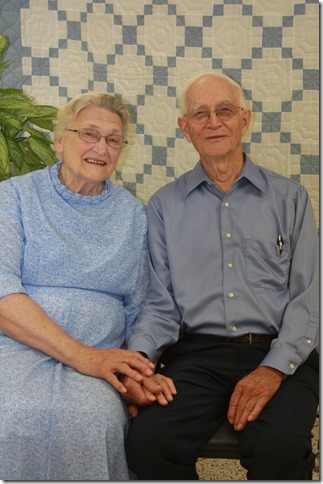
Orpha and Lloyd, 66 years together
A year ago I posted something on my wife's oldest sister and husband's 65th anniversary.

This past Saturday this same Orpha and Lloyd Gingrich celebrated their 66th by attending the wedding of Laura Gehman and Brian Ranck, a young couple from their church who greatly admired them and chose to get married on their special day, June 22. Orpha provided some of the beautiful ferns from her sun room for the occasion.

Lloyd and Orpha are just about the best friends and role models one could find anywhere. Our family has been warmed countless times by their hospitality, and our children still like to take their children to spend some time on the Richfield, Pennsylvania, farm of one of their favorite aunts and uncles.

The Gingrich children, seven in number, are a good reflection of the faith and values their parents demonstrated so well over so many years, as are the next generations of grandchildren and great-grandchildren.

What's their secret to a loving and lasting marriage? Lloyd and Orpha would be the first to say they have no such secret, that it's all about just loving and lasting, no matter what, along with keeping their faith strong and applying a bit of dry Gingrich humor when you're having a not so good day.

I find it hard to come up with a better route to "happily ever after" than that.

Thanks to daughter-in-law Deb Gingrich for the photo.

Saturday, June 22, 2013

Where's The Best Place To Raise Children?

Plano West Senior High School
You may have never heard of Plano, Texas, population 270,000.

A progressive, rapidly growing suburb of Dallas, Plano is a recent proud winner of the coveted All-America City Award. It has some of the finest homes oil money can buy, one of the best school systems in the state, and an overall crime rate said to be the lowest of any Texas city of over 100,000.

Compare that to Harlem, one of the densely crowded and crime ridden boroughs of New York City. Like many large urban areas, Harlem has more than its share of problems with illegal drugs, broken homes, bad schools, and teenage pregnancies.

Which is the better place to raise children?

Plano should be, of course. But in the mid-nineties it began to face a growing number of its teens, reporting feelings of worthlessness, boredom and depression, becoming addicted to heroin in a potent new capsule form. Seven of its young people, most of high school age and one only 13 years old, died of heroin overdoses in a year's time. Many more were rushed to local hospitals for emergency treatment because of the drug.

Not only heroin, but high potency, low cost meth and other drugs are also widely available through sources in nearby Mexico, and the use of pharmaceutical drugs also remains a huge problem among well to do school age children and young adults.
  
By contrast, one particular public school in the middle of Harlem has become widely known as a place where teens develop an amazing sense of pride and achievement. Children from all kinds of family backgrounds audition to become a part of the Choir Academy of Harlem, a school of 550 students from grades 4-12 best known as the home of the Harlem Girls Choir and Harlem Boys Choir. An impressive 98% of the school’s graduates, according to a recent report, go on to college, and most become highly successful adults.

This is not to suggest we all move to poverty-stricken Harlem, but what can we learn from this “tale of two cities”?

Maybe that our tendency to overprotect and over-provide for our children, in an effort to “save” them from stresses and problems, we may sometimes put them at greater risk. On the other hand, if we maintain high expectations for them, along with showing lots of love, support and encouragement, we can help motivate them to strive for true excellence.
  
Teens deprived of opportunities to take on high stakes, world-changing challenges or risks tend to explore unhealthy ones, like using alcohol and other drugs, having irresponsible sex, driving dangerously, and engaging in other irresponsible behaviors.
  
When it comes to teaching them good values and responsible behavior, it’s not so much where we live, but how we live and what we expect of our children that makes the winning difference.

Wednesday, June 19, 2013

How Retirement Investments Can Bring The Greatest Possible Returns

Everence image
For a long time I have advocated investing the bulk of one's retirement funds in Community Investment Funds that benefit the poor and help the environment rather than in Wall Street traded corporations. Our local financial adviser Glen Kauffman, with Everence Association Inc., a fraternal benefit society, has helped us do that through Calvert, MEDA, Oikocredit and similar organizations.

Now Everence is offering a special Advantage Select High Impact Annuity, a fixed annuity designed for individuals wanting to save for retirement while their money is helping others. It is basically a loan to organizations that do good and offers interest rates of 1-3%, just enough to help keep up with inflation

That doesn't result in much if any financial gain, but up to 50 percent of the annuity premium dollars provide loans for causes that are priceless:
  • Emerging and socially engaged congregations growing their ministries and community services.
  • Green lending for nonprofit organizations making environmentally friendly improvements.
  • Community development needs in underserved areas in the U.S. and around the world.
“We are excited to offer our members a way to help others while also saving for their own future,” said Michael Horn, Everence Director of Charitable Products and Church Loans. “The Everence Advantage Select High Impact Annuity gives people an opportunity to live out their faith and values through their financial decisions. It’s another way we are doing better, together.”

As a disclaimer, I am not a part of any organized effort to promote Everence or any of its products. But as one of its customers, I definitely approve this message.

Check this link to more posts on microlending.

Monday, June 17, 2013

Is It "Debts" or "Trespasses"?

Praying the Lord's prayer together often brings up the question of whether to use the word "debts" or "trespasses". In Reformed, Lutheran and Presbyterian circles, "debts" is standard, whereas with Roman Catholics, Episcopalians and Methodists, "trespasses" is the norm.

Some modern translations simply use the word "sins", assuming that debts and trespasses have identical meanings.

But do they?

In some research I did for our house church Bible study yesterday, I learned that John Wycliffe, in his 1395 English translation of the Bible, rendered the Gospel of Matthew's Greek word opheilema as "debts", simply because that word consistently refers to actual monetary or other debt elsewhere in the gospels.

In William Tyndale's 1526 English Bible, however, that same Greek word is translated "trespasses", and the first Book of Common Prayer published in 1549 followed that usage.

In the Gospel of Luke's version of the Lord's prayer, the Greek word for "sins" (hamartia) is used, as in "Forgive us our sins," but that is then followed by "as we forgive our debtors," using a form of the Greek word opheilema.

It's no wonder we're confused, but in any case, trespasses and debts don't have exactly the same meaning.

To illustrate the difference, when I walk to the Harmony Square Shopping Center from our house, I take the liberty to "trespass" across parts of two of my good neighbors' back yards. They have no  signs posted, and happen to be just fine with my taking this little short cut, but technically I have still trespassed. But the only "debt" I owe is one of gratitude for having such great neighbors.

But should I drive my loaded pickup over that same area of their back yards and right after a heavy rain,  then my trespass might well incur an obligation, or debt. At the very least, I could owe them a major apology, if not some actual compensation for damages, along with a commitment never to do the same thing again.

My neighbors would then forgive me based on my confession and repentance of my trespass. In the same way, every sin is a wrongdoing, a transgression that normally involves a debt we owe in the form of some kind of repentance, restitution, or both. In other words, one's debt has to do with how a trespass has harmed a relationship, in that there is now something "owed", either to God or to another person.

This suggests that sin is not just about violating a rule in a code of law, but is about violating the Bible's first and foremost commandments to love God with a passion and our every neighbor with compassion. "Owe no one anything," writes the apostle Paul, "but to love one another, for love is the fulfillment of the law."

(Note: To "owe no one" doesn't mean never doing any borrowing, of course, but making our payments on time so we are never in arrears.)

One could argue that all of this is no big deal, since we need to be forgiven of all debts, trespasses, sins, faults, flaws and wrongdoing, no matter what we call them. But my prayer remains that God and other people will forgive me not only my trespasses (or sins--both of commission and omission), but all of the unpaid debts I have incurred as a result.