Pages

Monday, January 8, 2018

Somebody Touched Me: An Epiphany Message

Monreale Cathedral mosaic of Jesus
healing a leper.
This is a meditation I gave at the Strite Auditorium at the Virginia Mennonite Retirement Community yesterday, Epiphany Sunday:

Two of the three gifts the Maji brought to Jesus, frankincense and myrrh, are widely known for their healing qualities. One can’t read the gospels without noting how much of Jesus’ ministry is about healing the sick, and about offering hope to the sick of heart, and how often Jesus, as the Divine Healer and Great Physician, touches people as he heals them. 

In some of those miracle accounts Jesus touches those who were considered untouchable. For example, Jesus touched an unclean leper in healing him, and touched the shroud of a widow’s son whom he raised to life, which would have made him ceremonially unclean. He likewise took a woman’s hand who was sick with fever and raised her from her bed, not something a Jewish male would typically do. 

And Jesus took children in his arms and blessed them, little ones who were at the bottom of the social ladder, often overlooked and neglected. And he took on the role of servant/slave and washed his disciples’ feet, one by one, and dried them with a towel. 

Jesus also allowed himself to be touched by others, by a woman who was considered unclean both because she was bleeding and because she was a Syrophoenician, a Gentile outsider. And Jesus allowed a woman, in more than one instance, to anoint his feet with perfumed oil, perhaps frankincense or myrrh, and/or with her tears, and to wipe his feet with her hair. Jesus understood the power of touching and being touched in restoring people to wholeness.

Touch is one of the first of the senses that an infant is aware of, and the last to leave when a person is dying. God gave us only two eyes for seeing, two ears for hearing, two nostrils for smelling, one tongue for tasting (with multiple taste buds), but hundreds of receptors all over our body for experiencing touch. It's vital to what make us feel alive to the world around us. 

When it came to showing affection, we weren’t a very demonstrative family growing up. It felt awkward to hug, until later in life some of us started giving our parents a warm embrace whenever we met. It wasn't long before they looked forward to it, and hugged us back.
    
I remember once holding my mother’s hand when she was in bed and suffering from cancer, and when I got up to leave, I spontaneously leaned over and gave her a kiss on her forehead. It was a special moment for both of us, and later she exclaimed to one of my siblings, “Harvey gave me a kiss!” as though that were something very rare and special. It shouldn't have been, but for us it was. It still is.
     
Years ago I was at Wellspring Retreat Center just outside of Washington, for a week, and Gordon Cosby, a pastor of the Church of the Savior and a writer I always admired, came and spoke to us. And then he had to leave while we were to continue on in our session. And as he was leaving he came by the aisle where I was sitting, and he turned around to add to something he wanted to say to us, and he happened to be right where I was sitting and he put his hands on my shoulder as he spoke a few more words. He hadn’t picked me out and I don’t think he had any idea how powerful that felt, to have this man of God touch me, as if to bless me, even though he wasn’t really conscious of doing that. 

We all need that kind of blessing, of people touching us, giving us benediction, laying hands on us and praying for us, or giving us an affectionate greeting. 

Have you ever thought of how many of our Christian practices have to do with touch? In the Mennonite church we used to speak of seven ordinances, somewhat like the Catholic Seven Sacraments. One was about greeting one another warmly, with a holy kiss, a kind of holy embrace, a command given repeatedly in the NT.  And then there is a laying on of hands at ordination, or at a commissioning, or in praying for someone in special need. Washing one another’s feet and drying them with a towel has been commonly practiced in many of our churches, a beautiful form of tender touch, especially important in Jesus’ time when people walked for miles every day on dusty roads.     

And at baptism, of course, we touch the head of the person on whom we pour the baptismal water. Or if we baptize by immersion we assist the person in their symbolic burial and resurrection to new life. We then take them by the hand and warmly welcome them into the family of faith.

When we anoint with oil for healing, we touch the forehead of the person being prayed for, in the name of the Father and the Son and the Holy Spirit. In the marriage ceremony, the officiants lay their hand on the joined hands of the couple as they declare them husband and wife, until death do them part. At the Lord’s Supper, we touch as we break bread and share with each other with the words of Jesus, "This is my body." "This is my life-giving blood," the bread and the cup of communion. 

Years ago I was at another retreat where a woman there, in her 50’s, poured out her heart over all of the pain she was going through because her husband had left her for a younger woman after their children were grown. She described her pain as being like being “cut in two with a saw”. And what made it harder was it seemed the people in her church didn’t know how to respond. “My phone didn’t ring as much anymore. People didn’t know what to say. And hardly anyone touched me anymore. I began to feel my body wasn’t OK, that I had become untouchable, at a time when I especially needed the assurance that I was still an OK lovable person."

But in a time that there is so much publicity being given to inappropriate touching, how do show the right kind of Christ-like love in ways that are absolutely safe and healthy? 

Here’s where we need to think of touching in the family of faith in the same way as we do in a healthy biological family. We instinctively know the difference between incestuous touch and appropriate touch. In the context of a healthy family, we show our affection in ways that are always in public, never secretive or in private, and in ways we all agree are appropriate for sisters and brothers and parents and children, uncles and aunts. We never favor certain people over others on the basis of any physical attraction or their gender or their youthfulness, but regard everyone in our family and in the family of faith, as beautiful and special and wonderful—not as sexual objects, but as loved and respected fellow siblings in the family of God, where there is total transparency and accountability, where we always ask, “Who, when and how, would Jesus touch? 

And then to follow his good example.

Here's the benediction used every Sunday in the church in which I grew up:

“Finally, brothers and sisters, shalom. Maintain good order. Listen to my appeal, encourage one another, live in peace; and the God of love and peace will be with you. Greet one another affectionately. All the believers greet you. The grace of the Lord Jesus Christ, the love of God, and the communion of the Holy Spirit be with you all.” Amen
- II Corinthians 13:11-4, paraphrased

Saturday, January 6, 2018

Two Nuclear Buttons--A Modern Day Parable

This 1945 blast should have resulted in an end to
nuclear warmongering.
The John and Jane Doe family and the Ilsa and Ivan Doesky family lived at opposite ends of a fine apartment building in Solarville. Being quite well to do, they were the envy of many of their neighbors in the same complex, many of whom were sick, hungry and living in overcrowded and unsanitary conditions.

Unfortunately, over time the Doe's and the Doesky's developed a strong mistrust of each other. "The Doe's act like they want to control and run everything," complained the Doesky's. The Doe's feared their estranged neighbors had the same intentions.

As the feud between them worsened, each household tried to get as many families on their side as possible. They also began keeping firearms and ammunition on hand just in case there was any trouble--handguns at first, then automatic rifles, then whole rooms full of powerful weapons.

Finally, to gain even greater advantage, the Doe's began to develop and test the ultimate weapon, napalm. It wasn't long, of course, before the Doesky's produced large stockpiles of their own.

The Does were appalled. "Now we need even more WMD's" they insisted, "in order to protect our freedoms and to maintain peace and security in the apartment."

It wasn't long before the Doe's and Doesky's had enough death-dealing napalm to completely annihilate each other. But since they still didn't feel safe, they kept producing even more, enough to destroy their enemy twice, then three times, and then multiple more times. A sophisticated wiring device made it possible for either family to blast and burn each other to oblivion in an instant, all at the touch of a button. Costs mounted, creating terrible strains on each of their family budgets.

All along some residents in the building questioned the sanity of all this. "Is this really a show of strength or is it a sign of fear and stupidity? How can this possibly make us safer?"

"What''s more," some worried, "what about the apartment's Builder and Owner? After all, we're only renters here. Surely the Landlord will evict us if we can't find a way to get along as neighbors and fellow-tenants."

Friday, January 5, 2018

On The Twelfth Day Of Christmas: Traveling Light

Growing up, our needs were simple, our possessions few.
The modest two-story country home my parents bought when they moved to Virginia with their eight children was the most spacious we had ever lived in. But like most farm homes built in the early 1900's there were no built-in closets in our bedrooms and only two small storage closets in the entire house. There were hooks on the bedroom walls for some of our clothes, with the rest of our garments having to be folded and stored in dresser drawers. We later did get a few small upright closets to add to our wardrobe space.

Our one toy box was about the size of a bushel basket, and we had fewer than a dozen book shelves in the entire house. The cellar did have ample space to store potatoes and lots of canned fruits and vegetables to help us through the winter.

Fast forwarding to 2018, Alma Jean and I are keenly aware of some of the encumbrances the Bible admonishes us to lay aside in light of the looming finish line. How did we manage to accumulate so much stuff, we ask ourselves, as we plan yet another trek to the landfill or another donation to Gift and Thrift?

And what about our children, and our grandchildren, who like many of today's families, have enough books, clothes and play equipment to stock a small nursery school?

Somehow as we all grew older and became less stressed financially, stuff just kept accumulating. So for us every day becomes a time to consider subtracting from our assets and adding to what we share with those who have less.

Meanwhile, our capacity for joy deepens as we experience more contentment with fewer things that just add more clutter in our lives.

Much love, many prayers.

Thursday, January 4, 2018

On the Eleventh Day Of Christmas: Celebrating Church

Zion Mennonite was just across the road
from our parsonage home from1969-88.
For most of the years I served as a pastor and part-time teacher our family lived in a parsonage across Zion Church Road from our congregation's meeting house. As parents we were always concerned about whether this would draw our three children closer to the church as a community of warmth and nurture or make them less receptive to being a part of a family of faith.

We always tried to stress that church isn't just about a special location, building, denomination or Sunday service, but an extended family of people united around a special purpose, a movement of Christ followers who care for each other and who continue to engage in the work Jesus came to earth to accomplish.

As Anabaptists, we knew their becoming a committed part of that kind of movement had to be a voluntary choice on their part, but hoped and prayed that they would feel called to sign on to that mission.

Meanwhile, we often asked ourselves the question of which should comes first, this kind of family of people heaven-bent on a common cause? Or should our nuclear family claim the greater amount of time and commitment?

Over time I have become convinced that the two should be seen as inseparable, that the nuclear family unit is most healthy and strong when it is a vital part of a larger beloved and loving community. In our case, we deeply appreciated the loving influence of people like the Millers, Algers, Brennemans, Blys, Kuykendalls, Lantz's, Showalters and others who were an important part of the "village" that helped raise our family. We couldn't have done this well without their reinforcing the faith and values we tried to pass on.

Much love, many blessings.

Wednesday, January 3, 2018

On The Tenth Day Of Christmas: Practicing Hospitality

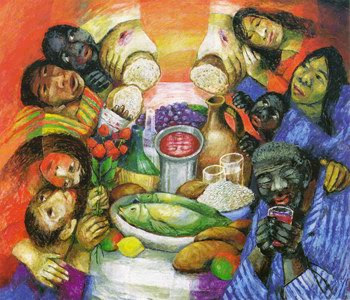
Sieger Koder's "Breaking of the Bread"
I always looked forward to guests coming to our house when I was young, whether nearby relatives and church friends for Sunday dinner or friends and family from a distance. There were very few Sundays that we weren't blessed with guests around our table or were invited to the homes of other members of our congregation. 

I was especially intrigued by having visitors from outside our rural community, including occasionally having some relatives and other students from exotic places like EMU (then EMC). Blessed by boredom as I was, I found myself entertained by adult conversations which not only included family and other stories, but were often about church issues and other matters of faith.

It's hard to overestimate how impactful these windows to the outside world were on my life, I'm thinking they played a huge role in shaping my values and envisioning my future. I often wish we could could have done more of that with our own children, for everyone's benefit, including offering more of the kind of hospitality Jesus encourages in welcoming the stranger and inviting the hungry and homeless into our home (as in "When you prepare a feast, don't just invite your friends and others who will likely return the favor, but invite the poor, the hungry, the lonely"). 

Our six grandchildren, blessed by being among the top few percent of the world's most privileged, will learn empathy and generosity not only from our words, but by our example, and by exposing them to a rich variety of good people in the real world outside our homes.

It's life changing.

Much love, may prayers.

Tuesday, January 2, 2018

On The Ninth Day Of Christmas: Offering Allowances

How do we help kids learn wise
money management?
As stated earlier, I'm not a proponent of paying children to do the kinds of chores every member of a household should take turns doing, but only for special projects one might hire someone else's son or daughter to do.

But some kind of fixed "salary" (allowance) for younger members of the household (kindergarten age and up), as a means of learning good lessons in money management, can be a very good thing, and needn't cost the household a dime.

How is that, you ask? By basing the allowance on the amount of money we are already doling out for a defined set of miscellaneous items (recreational and optional in nature) that they will now be personally responsible to pay. The defined items might start with candy bars and ice cream cones for the young to eventually having them purchase their own clothes, shoes, etc., as teens. In other words, they become responsible to manage that part of the family's finances, and learn through buyers' remorse to make wise purchases as well as to learn to live within their prescribed budget. 

Thus no more begging for things on their list for which they should have ample funds to pay for. Whether, or what, they buy will be totally up to them, as long as the purchases are legal, not harmful, and within budget, all in an effort to help them learn how life in the real world works.

Loans can be requested from a "First Family Bank of Savings and Loans", but they should carry a hefty weekly interest, deducted from the next allowance payment. The rate of interest will be the same as the First Family Bank will pay per month if the child chooses to save some of their allowance. And to encourage generosity, parents might also agree to match each child's giving to the church or to the charity of their choice.

Another component of this plan can be to have a well defined Family Legal System (a set of family rules everyone is expected to abide by), then to have a well-understood fine system that results in a modest monetary amount deducted for each infraction. Giving a fine should, by the way, never be accompanied by a lecture or lengthy sermon, but delivered in the way a professional police officer would write a traffic ticket, or a supervisor at work write up an employee for violating company policy. Thus children learn from reasonable consequences, respectfully and consistently carried out,  again based on the way the real world works. Examples of fines could be a deduction for household chores not done, or for taxi service if a child doesn't get him or herself out of bed, dressed and on the bus in time. Or for hitting or yelling. The amount of a fine, predetermined so there are no surprises, is reasonable and based on the amount of income.

This doesn't mean there aren't other consequences for other infractions, based on some kind of "restorative justice" (acknowledging a harm done and making it right). But in all of the above ways children learn from their own choices, and learn that it is wiser to live by the rules. These rules remain firmly in place until or unless modified by parents or brought about by agreements made in occasional family council meetings.

Much love, many blessings.

Monday, January 1, 2018

On The Eighth Day Of Christmas: Teaching Responsibility

Children find it rewarding to do meaningful grownup work.
Some time ago I read an article that suggested that by the time children leave home they should have learned all the skills needed to manage and maintain a household of their own, that is, how to take care of finances, pay bills, prepare healthy meals, clean house, take care of clothes, and do minor repairs. Such instruction is a part of our job description as parents.

I know that sounds like a lot of work, and it may feel easier and more efficient just to do a lot of the household chores ourselves, but children really need (and won't necessarily resent) the challenges involved in upgrading their skills and their level of responsibility to more adult levels. They will resent our nagging, complaining and treating them disrespectfully in the process, of course. 

Until the widespread availability of many of today's screen-based games, much of children's play involved imitating adult work, playing the roles of admired grownups in their lives, which makes play a vital part of their education. Of course children will always dislike the same kind of tasks we all dislike, the boring and repetitious kind, the kind we all need to take turns doing simply because we are a responsible part of the household, like washing dishes, cleaning or making beds. 

All such work is an important part of being a responsible and functional adult. Meanwhile,  I've become less inclined to favor paying children for these kinds of normal and necessary shared chores, but to pay them only for special jobs we might normally hire some other outside person to do for us. In those cases, they can make a competitive bid for the job and be hired to do it, all as a part of learning how the real world works.

I do, however, believe in giving school age children a regular allowance as their "salary" (with annual increases) with their then becoming responsible for more and more of their own purchases. But more on that in my next post.

Much love, many blessings.